The Quiet Move Before the Combination
A tactic often begins with a move that seems to do nothing. Learn to spot how improving a piece or removing a defender can make the forcing sequence work.
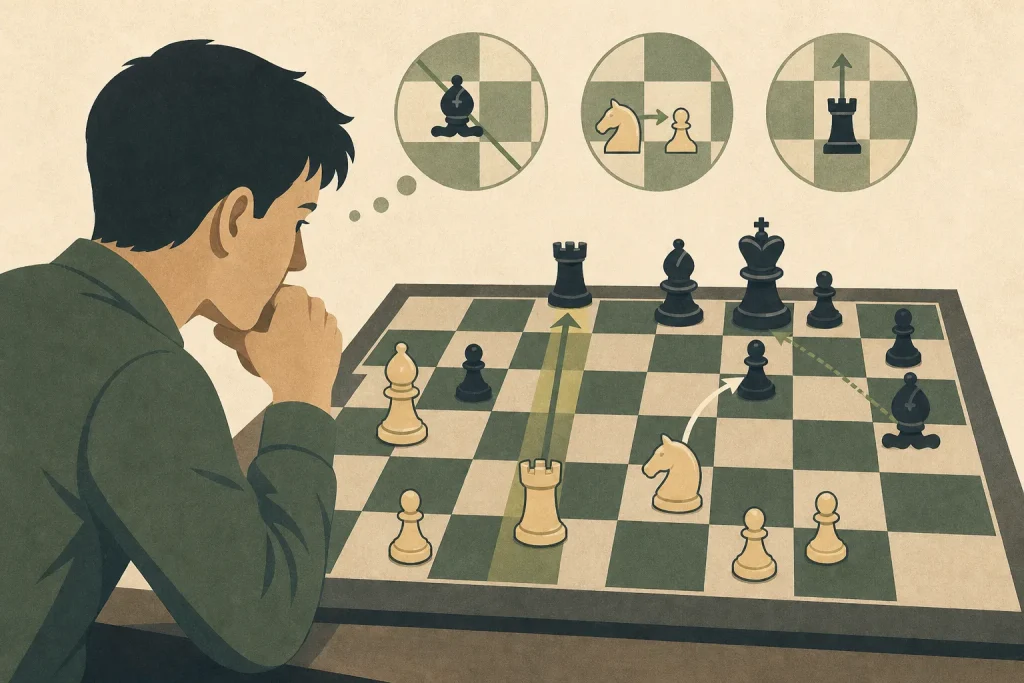
The common mistake is to start calculating only after a check or capture appears. That costs you the chance to notice the quiet move that makes the combination sound: a rook shifts onto an open file, a bishop gains a useful diagonal, or a defender is lured away. Before asking what you can take, ask what must change for the tactic to work.
Find the missing condition
A combination usually depends on a concrete detail: a king has few escape squares, a defender is overloaded, or two targets line up. If the position has a tempting tactic that nearly works, identify exactly why it fails. The missing condition often points to the preparatory move.
For instance, a rook may be ready to invade the seventh rank, but an enemy bishop controls the entry square. A direct rook move does not solve the problem. First look for a way to distract that bishop, block its line, or improve another piece so the rook’s entry comes with a threat.
Keep the question specific. “Can I improve?” is too broad; “Which piece prevents my rook from reaching the target?” gives calculation somewhere to start. If no single piece or square is holding the position together, the apparent combination may simply not be there.
Improve the attacker
A quiet move can add force without changing the target. A knight may step to a square from which it attacks a defender and supports a later fork. A queen may move off a vulnerable file while keeping an eye on the king. A rook may double behind a pawn before opening the file.
Check what the improved piece threatens and what your opponent can do about it. A useful preparatory move should either create a new tactical threat, strengthen a forcing continuation, or make the opponent’s best defence awkward. A move that only looks more active, with no concrete follow-up, is not enough.
Say you have a bishop aimed at the enemy king, a rook on a half-open file, and a knight that currently blocks the rook’s path. Imagine you move the knight to a square where it attacks a pawn beside the king. The expected observable change is that the opponent must address the pawn threat or allow the rook’s file to open; you can then calculate whether the resulting checks or captures actually work. If the opponent can calmly move the king or trade the rook, the quiet move has not prepared a sound combination.
Remove a defender
Many tactics fail because one enemy piece guards two things at once. It may protect a rook while also covering a mating square. The quiet move can exploit that workload by attacking a second target, forcing the defender to choose.
Look for a move that creates a credible threat elsewhere on the board. If the defender leaves its post, the original target may fall; if it stays, the new threat may become decisive. Calculate both replies rather than assuming your opponent will make the move that helps you.
There is a difference between attacking a defender and making it move. A piece can often ignore a threat if the threatened object is adequately protected. Before committing, ask whether the opponent has a defence that keeps the guard in place, such as a counterattack, an exchange, or a move that adds protection.
Check the opponent’s reply
Quiet moves give the opponent time, so they demand honest calculation. After your candidate, search for forcing replies first: checks, captures, and threats against your queen or king. Then consider whether the opponent can simplify by trading the piece you meant to use in the combination.
Also check for a defensive move that changes the geometry. A king can step out of a mating net; a bishop can interpose on a critical diagonal; a rook can challenge the file you hoped to occupy. If one reply spoils your follow-up, see whether your quiet move has another purpose or whether it should be rejected.
Do not stop at the first attractive line. Write the sequence in short form—your move, their best reply, your forcing continuation—and verify the final position. A tactic that wins material in one variation but leaves your king exposed in another may not be worth starting.
Use a short scan
When a tactical idea feels close but not ready, pause before calculating every branch. Use this compact scan to locate the missing condition:
- Name the target. Identify the king, loose piece, weak back rank, or overloaded defender your combination would exploit.
- Find the blocker. Ask which enemy piece, pawn, or square prevents the forcing move from working.
- Improve one attacker. Consider a rook lift, a queen repositioning, or a knight move that adds a threat without losing contact with the target.
- Test a distraction. Look for a second threat that forces the defender to choose, and check whether the threat is strong enough to demand a reply.
- Calculate the best defence. Give your opponent the most stubborn response, including a countercheck, exchange, or king escape.
- Recheck the position. Make sure your prepared tactic still works after that reply and that you have not left a piece en prise.
Use the scan as a filter, not a recipe. If the first quiet move does not create a concrete change, move on. A position can contain several active-looking moves, but only one may force the opponent to answer a real problem.
Read the new position
After a quiet move, compare the position before and after it. Which square is now controlled? Which defender has a harder task? Has a line opened, or has a piece gained a new route? Naming the change helps you distinguish preparation from wishful thinking.
In a study session, pause at the position just before the combination and record the candidate quiet move alongside the reason it works. Then calculate the opponent’s strongest reply before revealing the continuation. This trains you to notice the structural clue—the missing defender, blocked file, or misplaced attacker—instead of memorising a move sequence detached from its position.
The best quiet move often looks modest on the board. Its value lies in the question it leaves the opponent: defend one target and concede another, or alter the position and allow the forcing sequence. Before playing it, make sure that question is real—and that you know what you will do after the answer.
Related positions
A Game Score That Teaches You Something
Turn a recorded chess game into a useful study session by separating what happened from what…
Opposition and the Square You Cannot Cross
Learn to treat opposition as a contest for king access: identify the target square, choose the…