A Game Score That Teaches You Something
Turn a recorded chess game into a useful study session by separating what happened from what you think it means, then checking your decisions against the position.
The common mistake after a chess game is to replay it with the engine switched on and stop at every red mark. That can show where the moves diverged from the computer’s preference, but it rarely explains what you saw, what you missed, or why the position became difficult. A better review begins with your own score and a few deliberate notes.
Set aside one quiet session after the game, or the next morning if you are tired. You will need the score in a PGN viewer such as lichess.org’s analysis board or a desktop programme such as SCID, a board for setting up positions, and a notebook or plain text file. The sequence matters: record observations first, evaluate decisions second, and use an engine only after you have made your own assessment.
Prepare the score
Load the game without an engine evaluation bar. If you have a handwritten scoresheet, enter the moves into a PGN viewer, checking that the colours, move order and result are correct. A misplaced move can send the whole review into a position that never occurred.
Keep the game result out of your first notes. Winning does not mean every decision was sound, and losing does not mean the whole game was poor. For now, the score is a sequence of positions and choices, not a verdict on your play.
Choose a practical limit before you start. A short game may need only a focused session; a long or complicated one can be split across two sittings. Stop when your notes become repetitive or you are no longer able to explain a position in your own words. Continuing just to finish the score often turns review into mechanical clicking.
Mark turning points
Replay the game once at a steady pace. Pause where the character of the position changes, not after every move. Useful moments include a trade that alters the pawn structure, a king that loses its shelter, a piece that becomes trapped, a pawn break that opens a file, or a decision to enter an ending.
Mark these moments with a simple symbol in your notes, such as a star or a question mark. For each one, write the move number and a neutral description of what changed. Prefer “the queens came off and my isolated pawn became a target” to “I ruined the position”. The first sentence identifies a feature you can inspect; the second mixes a judgement with a conclusion.
Also mark moments when you felt uncertain during the game, even if the move looks ordinary on a replay. A quiet defensive move can be a turning point if it was the only way to prevent a threat. Conversely, a dramatic capture may not have changed the position much if the opponent had an easy reply.
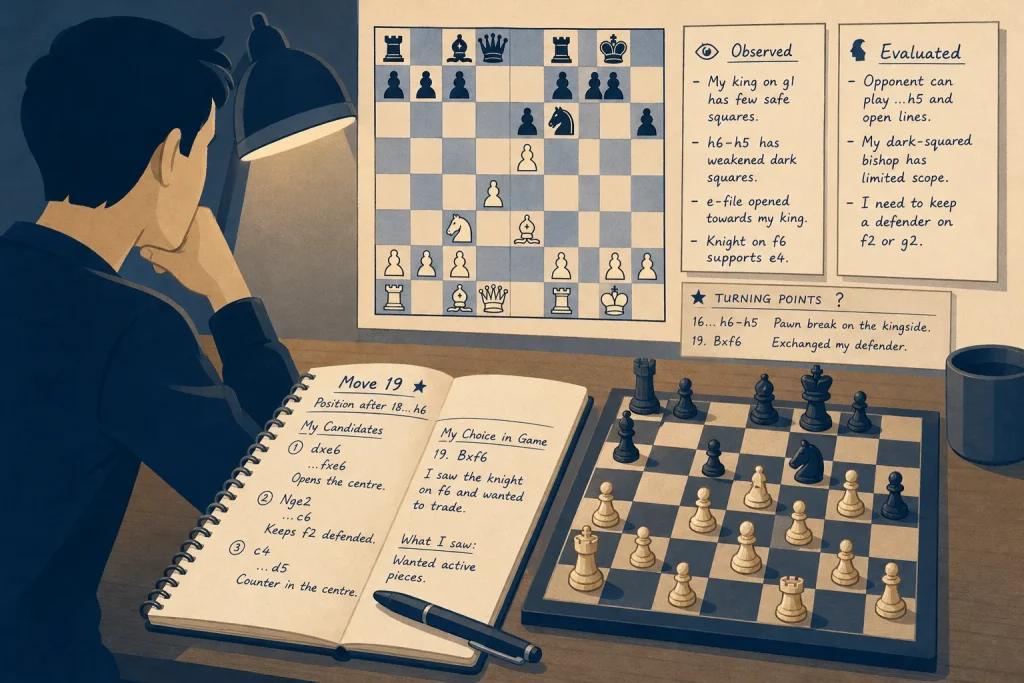
Say you played a middlegame in which your opponent advanced a pawn beside your castled king. On the replay, you notice that you exchanged a defender a few moves later. Mark both moves, then describe the board: which squares became weaker, which pieces were exchanged, and what lines opened. Do not yet write that the exchange caused the loss; that is a claim to check.
Separate seeing from judging
At every marked position, make two short notes under different labels: “Observed” and “Evaluated”. Under “Observed”, record visible facts: a piece is attacked, a file is open, a pawn is backward, or a king has few safe squares. Under “Evaluated”, record your interpretation: a rook exchange may favour the side with the passed pawn, or a knight may be poorly placed because its useful squares are controlled.
This separation prevents an opinion from masquerading as a fact. “My bishop was bad” is an evaluation. “My bishop was blocked by my own pawns on light squares” is an observation. The evaluation may be right, but the observation gives you something concrete to verify and may reveal a different remedy, such as changing the pawn structure or rerouting the bishop.
Keep the notes compact. One or two sentences for each label is enough. If you cannot explain why a feature matters, leave it as an open question rather than filling the page with confident guesses.
Rebuild your choice
At a turning point, cover the moves that followed and set up the position on a physical board or in the viewer. Give yourself the same side to move as in the game. Before looking at the played move, write down the candidate moves you would consider now.
Do not list every legal move. Choose a small set that reflects distinct ideas: a forcing check or capture, a direct response to the opponent’s threat, and a quieter move that improves a piece or prevents a problem. For each candidate, note the opponent’s most natural reply and what position you expect to reach. This is not an attempt to calculate every branch. It is a record of the choices you can explain.
Then compare your list with the move you actually played. Ask what was available to you at the board. Did you reject a candidate because it looked unsafe? Did you miss the opponent’s threat? Did you choose a move quickly because the position felt familiar? Write down the reason as accurately as you can remember it, without rewriting your thought process to make it sound better.
In the invented king-side example, imagine you now list a pawn exchange, a retreating move that keeps a defender, and a counterattack in the centre. You note that the exchange opens a file towards your king, while the retreat leaves the centre under pressure. That comparison does not prove which move was best; it gives you specific lines to examine and shows whether your original decision addressed the danger you had noticed.
Check the variations
Only after recording your candidates should you consult an engine. First look at the opponent’s best replies to your move and to the alternatives. If the engine recommends a move you did not consider, pause the analysis and work out its point before following the displayed line. Is it a defensive resource, a tactical shot, or a quiet improvement that changes a key square?
Use engine lines to test your reasoning, not to replace it. A sharp evaluation swing can direct attention to a hidden tactic, but the useful lesson is the position’s mechanism: a pinned piece, an overloaded defender, a loose back rank, or a king caught in the centre. Add that mechanism to your notes in plain language.
When a long engine line appears, follow it only until you understand the idea or the position settles into a recognisable result. If you cannot follow the line, return to the board and ask simpler questions: what is threatened, what can be captured, and which pieces are left undefended? You may also switch the engine off and calculate one candidate against a human-style reply before checking again.
Finish this part by comparing your evaluation with the position that actually arose. If you expected a safe exchange but the opponent had a forcing intermediate move, note the missed feature. If your plan was sound but you misjudged a later detail, keep those as separate lessons. A decision can be sensible with the information you noticed and still contain a tactical oversight; treating them as one failure makes it harder to improve either skill.
Turn notes into practice
End the session with one or two lessons that describe an action you can repeat. “I should play better” is too broad. “Before exchanging a defender near my king, check whether the opponent can open a file with tempo” gives you a question to ask in a future game.
Make a small practice position from the turning point if the tactic or defensive idea is easy to reconstruct. Save the FEN or PGN position in a study file and add a note that hides the answer until you have considered candidate moves. If the lesson is strategic rather than tactical, save the position with your observation and evaluation notes instead of forcing it into a puzzle.
At the next review, check whether the same decision pattern appeared again. Perhaps you repeatedly trade pieces without considering which pawn structure remains, or spend time calculating an attack while ignoring a direct threat. Add a new note only when the position gives you a concrete reason; do not turn one game into a sweeping rule.
Keep the record useful
Use a consistent entry for every game: the turning-point move, what you observed, what you evaluated, the candidates you considered on review, and the lesson to revisit. Keep uncertainty visible. A note such as “I do not yet understand why this rook ending is worse” is more useful than copying an engine label you cannot explain.
Over time, the score becomes a record of your decision habits as well as the moves. You can see which details you notice, which candidates you tend to omit, and where your evaluation changes after calculation. When you return to a saved position, begin again with the board rather than reading your old answer first. That small delay makes the review active: you have to observe, choose, and explain before you know what you wrote last time.
Related positions
Opposition and the Square You Cannot Cross
Learn to treat opposition as a contest for king access: identify the target square, choose the…
Choosing a Plan When Both Wings Matter
When both sides of the board offer chances, compare pawn breaks, piece routes and the opponent’s…